
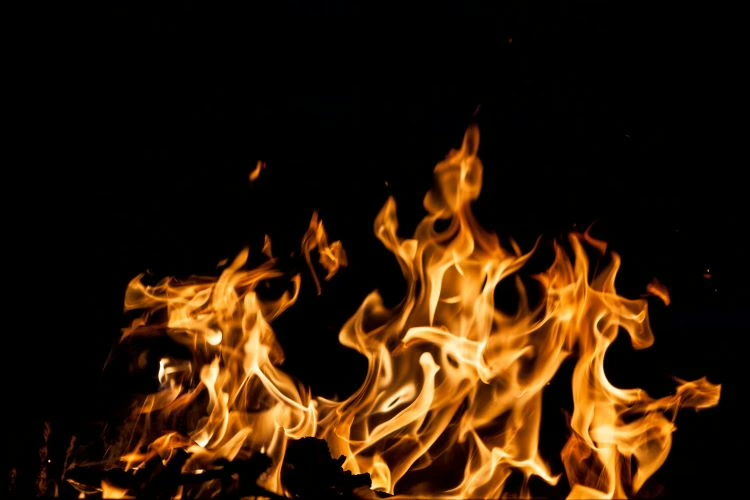
Washington’s Arson Laws
An arson investigation can quickly become one of the most serious criminal cases a person can face. In Washington, prosecutors aggressively pursue arson allegations because these offenses often involve significant property damage, the risk of serious bodily injury, and substantial financial losses. Depending on the circumstances, an arson conviction can result in years in prison, steep fines, and a permanent felony record. In some situations, federal prosecutors may also become involved, exposing a defendant to even harsher penalties.
If you have been accused of intentionally setting a fire or causing an explosion, it is important to understand the laws that apply to your case. Below is an overview of Washington’s first- and second-degree arson statutes, as well as the federal laws that may apply in certain circumstances.
What Is First-Degree Arson Under Washington Law?
RCW 9A.48.020 defines Arson in the First Degree. A person commits this offense if he or she knowingly and maliciously causes a fire or explosion and, by doing so, damages:
- A dwelling,
- Property in which another person has a possessory or proprietary interest and the fire knowingly places another person in danger of death or bodily injury, or
- A building or structure in which a human being is present at the time of the fire or explosion.
First-degree arson is a Class A felony, making it one of the most serious property crimes under Washington law. A conviction can result in substantial prison time, significant fines, restitution, and other long-term consequences.
To obtain a conviction, prosecutors must prove each element of the offense beyond a reasonable doubt, including that the defendant acted both knowingly and maliciously.
What Is Second-Degree Arson Under Washington Law?
RCW 9A.48.030 governs Arson in the Second Degree.
A person is guilty of this offense if he or she knowingly and maliciously causes a fire or explosion that damages a building or structure under circumstances that do not rise to first-degree arson.
Unlike first-degree arson, second-degree arson generally involves situations where the fire does not place another person in danger or involve an occupied dwelling. Nevertheless, the offense remains extremely serious.
Second-degree arson is a Class B felony in Washington. A conviction may result in years of imprisonment, substantial financial penalties, restitution, and a felony record that can affect employment, housing, and professional licensing opportunities.
When Does Arson Become a Federal Crime?
Although most arson cases are prosecuted in Washington state courts, certain fires may also violate 18 U.S.C. § 844, the primary federal arson statute.
Federal prosecutors may pursue arson charges when a fire or explosion involves property used in or affecting interstate or foreign commerce. Examples include:
- Commercial businesses,
- Apartment complexes or rental properties,
- Government buildings or federal facilities,
- Property owned or occupied by the United States, and
- Other buildings with a sufficient connection to interstate commerce.
Federal law also criminalizes using fire or explosives to commit another federal felony and prohibits damaging or destroying federal property by fire or explosion.
Federal arson convictions often carry severe penalties, including lengthy mandatory prison sentences in some cases. When an arson results in serious bodily injury or death, the penalties increase dramatically and may include decades in federal prison or even life imprisonment, depending on the facts of the case.
Can a Defendant Raise a Legal Defense?
Fortunately, people facing an arson charge can contest it with a legal defense. Recall that you are only guilty of arson in the first degree if you acted “knowingly and maliciously.” A defense, then, is for you to show that you did not act with either of these aims. Maybe, for example, you just started a fire on accident or with no evil intent.
You can also try to challenge an arson charge by showing that you were falsely accused. It may be the case that someone blamed you of a crime out of anger or revenge. In this case, you can raise the defense that you were unjustly blamed.
Contact Black & Askerov for Help
While a defendant can raise a legal defense to challenge an arson charge, it will take a skilled criminal defense attorney to raise the best defense. The experienced criminal defense attorneys at Black & Askerov have over 30 years of combined experience defending clients on criminal charges. Our Seattle criminal defense lawyers also have the skill and commitment that makes all the difference in these cases. Contact us now to get the legal help you deserve!
* Main image at top from freepik
Related Posts
Recent Articles